Organic, not mineral
Amber is fossilised plant resin. Its organic origin is one reason its appearance and internal structure differ from crystalline gemstones.
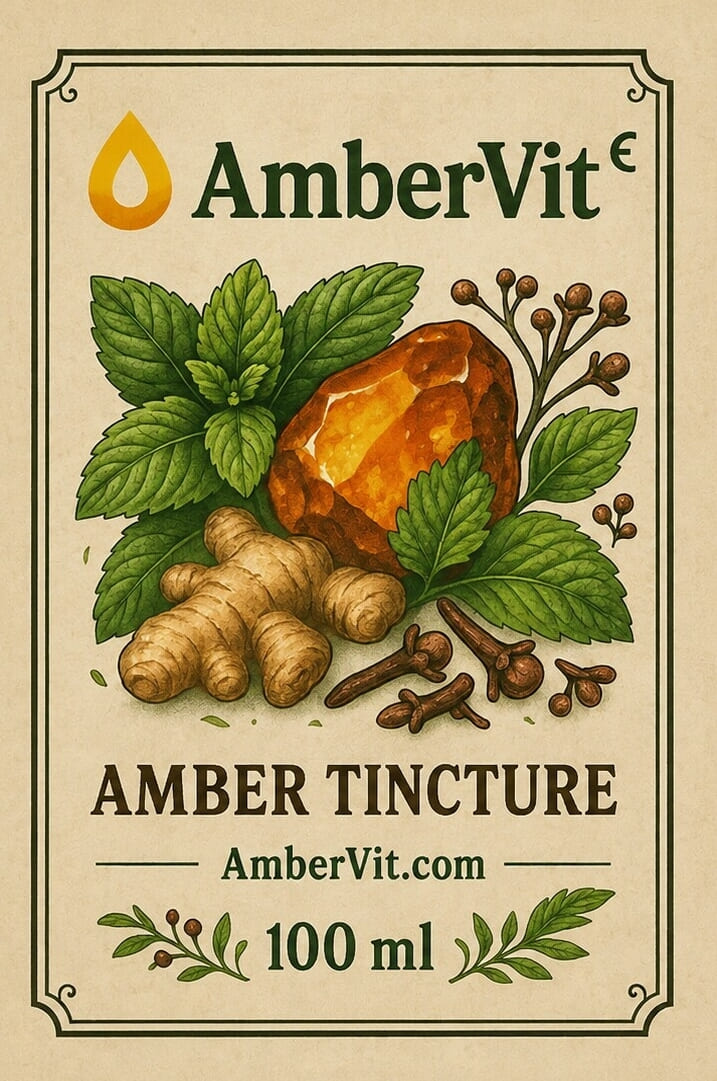
Kit for preparing Baltic amber tincture according to a traditional recipe.
Baltic amber, also known as succinite, is fossilised tree resin formed approximately 40 million years ago during the Eocene. Valued for its warm colour, organic character and remarkable inclusions, it is one of the best-known natural materials associated with the Baltic region.
Amber is not a mineral or a conventional gemstone formed from rock. It is an organic fossil resin whose structure, colour and transparency can vary naturally from piece to piece.
Baltic amber originated from resin produced by ancient trees in northern Europe. Over millions of years, the resin was buried, chemically transformed and hardened into the fossil material known today as amber. Geological processes later moved amber-bearing sediments across a wide area around the Baltic Sea.
The International Amber Association identifies Baltic amber as succinite. It is distinguished from other fossil resins by characteristic physical and chemical properties, and professional laboratories can identify it using methods such as infrared spectroscopy.
Amber is fossilised plant resin. Its organic origin is one reason its appearance and internal structure differ from crystalline gemstones.
Baltic amber is generally dated to the Late Eocene, approximately 40 million years ago, when extensive forests covered parts of northern Europe.
Ancient rivers, marine sediments and later glacial processes redistributed amber far beyond the forests where the original resin was produced.
Natural Baltic amber occurs in many shades and degrees of transparency. Two genuine pieces can look very different while still belonging to the same natural material. Colour alone is therefore not a reliable test of authenticity.
Common appearances include pale yellow, golden honey, orange, cognac, brown, cream and reddish tones. Natural weathering can also affect surface colour.
Baltic amber can be transparent, translucent or opaque. Microscopic bubbles and internal structures may create cloudy, milky or almost foam-like varieties.
Raw amber can occur as irregular pieces, drops, plates and other forms. Polishing reveals the internal colour and structure but changes the natural surface.
Resin can trap tiny organisms and plant material before it hardens. When preserved in amber, these inclusions may provide scientists with three-dimensional evidence of life from millions of years ago.
A visible inclusion does not automatically make a specimen authentic: imitation amber and composite objects can also contain inserted material. Valuable or unusual inclusions should be assessed by a specialist.
Baltic amber is important not only in jewellery and decorative art. Its inclusions and chemistry are studied in palaeontology, biology, geology, archaeology, chemistry and gemmology.
Baltic amber has a combination of properties that helps gemmologists distinguish it from other fossil resins and from imitations. Individual observations are useful, but professional identification relies on several characteristics considered together.
Amber has a Mohs hardness of approximately 2.0–2.5. It is much softer than many mineral gemstones and can be scratched if stored or handled carelessly.
Amber is lightweight. Genuine amber can float in a sufficiently concentrated salt solution, although this is only a preliminary observation and not proof of Baltic origin or authenticity.
Succinite contains naturally occurring succinic acid as part of its chemical composition. Published Baltic amber references commonly report approximately 3–8%, with variation within the material.
Baltic amber can show characteristic fluorescence under ultraviolet light, often in blue or blue-green tones. Fluorescence alone is not a definitive authentication method.
When rubbed, amber can acquire an electrostatic charge. This well-known property has been observed since antiquity, but it is not sufficient to distinguish amber from every imitation.
Amber is an organic material that can be damaged by excessive heat. Burning or heating a specimen as a home identification test is not recommended.
Not every product sold as “amber” has the same structure or treatment history. The International Amber Association uses specific categories that help describe how Baltic amber has been processed.
Natural succinite may be cut, ground, polished, drilled or turned, but its appearance and structure have not otherwise been deliberately modified.
Natural amber whose appearance, texture or durability has been altered, for example by heat, pressure, dyeing or other treatment methods.
Material made by combining multiple pieces of Baltic amber under elevated temperature and pressure without additional components.
An object consisting of two or more pieces joined together with the minimum amount of bonding material required to connect them.
Several popular tests are frequently described online, but none of them should be treated as conclusive on its own. Plastics, other natural resins, treated amber and composite materials can sometimes produce similar results.
Look at colour, transparency, surface structure, internal features and workmanship. Perfectly uniform appearance can be a reason for closer examination, but natural amber can also be unusually clear or regular.
Baltic amber commonly fluoresces under ultraviolet light, but fluorescence can vary and some treated or imitation materials may also react. UV is therefore supportive, not definitive.
Amber can float in a saturated salt solution because of its low density. Ordinary seawater is not equivalent to a saturated test solution, and floating does not prove that a sample is Baltic amber.
Heat can permanently alter, darken, crack or burn amber. Destructive smell or hot-needle tests are inappropriate for jewellery or any specimen you want to preserve.
Gemmological laboratories can examine amber with microscopy, ultraviolet light and infrared spectroscopy. IR analysis is especially useful for distinguishing Baltic amber (succinite) from many other resins.
If origin, treatment status or value matters, use a qualified gemmologist or a specialist amber laboratory rather than relying on a single household test.
Amber is softer and more heat-sensitive than many mineral gemstones. Simple, gentle care helps preserve its surface and colour.
Baltic amber has been valued for thousands of years and continues to be used in jewellery, carving, decorative objects, collections and scientific study. Its importance comes from both its appearance and its cultural and natural history.
Amber is commonly polished into beads, cabochons and free-form shapes, or carved into decorative and artistic objects.
Unusual natural forms, colours, historical objects and scientifically significant inclusions are collected and preserved by private collectors and institutions.
Researchers study amber chemistry, fossil inclusions, geological deposits, ancient trade routes and historical craftsmanship.
Amber has a long history in European and Baltic folk traditions. Historical sources describe decorative, household and traditional apothecary uses. These traditions are culturally interesting, but they do not establish that amber can diagnose, prevent or treat disease.
Baltic amber has played an important role in regional craft, trade and decorative arts for centuries.
Historical and folk sources describe various amber preparations, including extracts and external-use preparations.
AmberVit presents traditional and historical information for educational purposes and does not claim that Baltic amber is a medicine or proven treatment.
Baltic amber is fossilised tree resin from the Baltic region. It is commonly known as succinite and formed approximately 40 million years ago during the Eocene.
No. Amber is an organic gem material formed from fossilised plant resin. It is not a crystalline mineral.
Succinite is the established gemmological term for Baltic amber. It has characteristic chemical and physical properties that allow specialists to distinguish it from many other fossil resins.
No. Most genuine amber does not contain visible insects. Natural inclusions can include plant material, tiny organisms, bubbles or other internal features, but their absence does not indicate imitation.
A low-density amber sample may float in a saturated salt solution, but the test is not conclusive. Some imitations can produce similar results, and floating does not confirm Baltic origin.
Baltic amber often shows blue or blue-green fluorescence under ultraviolet light. However, fluorescence varies and should be used only as one part of an identification process.
For reliable identification, use a qualified gemmologist or specialist amber laboratory. Professional examination may include microscopy, UV observation and infrared spectroscopy.
Clean amber gently with lukewarm water, mild soap and a soft cloth. Avoid ultrasonic cleaners, steam, aggressive chemicals, solvents and excessive heat.
Learn more about selected raw Baltic amber and discover the AmberVit preparation kit inspired by the traditional use of amber in the Baltic region.
The content on this page is provided for informational, educational and historical purposes. References to historical or traditional uses of amber do not constitute medical advice, a therapeutic indication or a guarantee of health effects.