The history of amber
From ancient forest resin to the treasure of the Baltic
The History of Baltic Amber
Baltic amber has fascinated people for thousands of years with its warm colour, lightness, glow and extraordinary origin. It is not a stone or mineral, but fossilised tree resin whose history began roughly 40 million years ago in the forests of northern Europe.
Follow the story of amber from the Eocene forest and ancient trade routes to the Amber Road, Baltic craftsmanship, folklore, scientific research and the modern culture of the Baltic region.
Baltic amber at a glance
- Fossilised tree resin, not a mineral
- Formed approximately 40 million years ago
- Historically associated with the Baltic Sea region
- Traded across Europe since prehistoric and ancient times
- Valued in jewellery, craft, culture and science
- A continuing symbol of Baltic natural heritage
The beginning of the story
How Did Baltic Amber Form?
The story of Baltic amber began during the Eocene, approximately 40 million years ago, when extensive forests covered parts of what is now northern Europe. Resin produced by ancient trees flowed down trunks, collected in damaged wood and sometimes trapped small organisms, plant fragments, air bubbles and other natural material.
After burial, the resin changed slowly over geological time. Volatile components were lost, the material hardened and polymerised, and erosion and sediment transport later moved amber into river systems, coastal deposits and sediments around the Baltic basin.
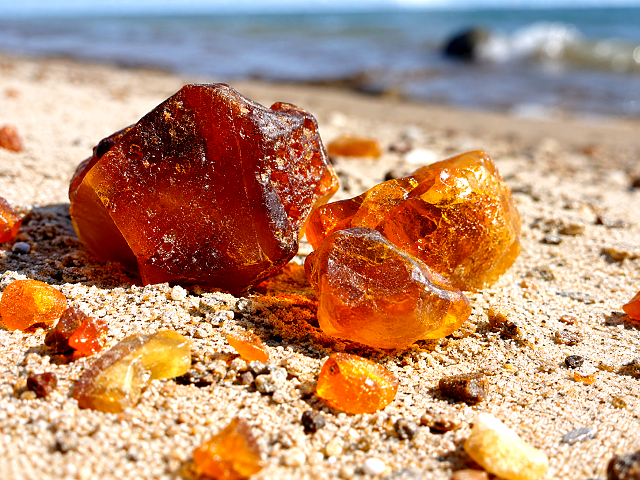
The result is an organic gem material that can range from pale yellow and honey to orange, cognac, brown and creamy opaque varieties. Each piece records a different combination of natural processes, which is why no two pieces are exactly alike.
What makes Baltic amber distinctive?
- organic origin as fossilised plant resin,
- approximately 40 million years of geological history,
- natural variation in colour, transparency and texture,
- occasional biological and botanical inclusions,
- association with the historic Baltic amber deposits,
- an exceptionally long cultural and commercial history.
Nature preserved in resin
Amber as a Window into Ancient Ecosystems
Amber has scientific importance because resin could trap and preserve small organisms and plant material before fossilisation. Inclusions may include insects, arachnids, plant fragments, pollen, fungi, feathers, hairs, bubbles and other microscopic structures. These inclusions give researchers three-dimensional evidence of life and environments that existed millions of years ago.
Ancient insects
Small insects and other arthropods could become trapped in sticky resin and later preserved in remarkable detail.
Plants and pollen
Botanical inclusions help researchers reconstruct parts of the vegetation and climate of the ancient amber forest.
Scientific record
Baltic amber is an important material for palaeobiology, geology, archaeology and gemmology.
Key stages
A Short History of Baltic Amber — Timeline
Trade and exchange
The Amber Road
The term Amber Road describes the network of ancient trade routes through which amber from northern Europe moved southward through central Europe toward the Mediterranean world. It was not one single paved road, but a changing system of land and river connections linking communities, markets and cultural regions.
Archaeological evidence shows that Baltic amber travelled over long distances in prehistoric and ancient times. By the Roman period, amber from the north was a valued luxury material in southern Europe and was worked into jewellery, beads, ornaments and prestige objects.
The trade in amber helped connect the Baltic coast with central Europe and the Mediterranean, making amber not only a material object but also part of a wider history of travel, exchange, craftsmanship and cultural contact.
Why was amber so valuable?
- its warm colour and ability to transmit light,
- its relative rarity away from northern source areas,
- its suitability for carving, beads and jewellery,
- the symbolic meanings attached to it in different cultures,
- its unusual organic origin,
- the prestige associated with long-distance traded materials.
Regional heritage
Baltic Amber in Poland and Around the Baltic Sea
The cultural history of amber is inseparable from the Baltic region. Poland, Lithuania, Latvia and the historic amber-producing areas around the southeastern Baltic became strongly associated with the collection, trade and working of amber. Storms can still wash pieces onto Baltic beaches, while important deposits also occur in sediments.
Polish Baltic coast
Amber has long been associated with Baltic beaches, coastal communities and the visual identity of the Polish seaside.
Gdańsk
Gdańsk became one of Europe’s best-known centres of amber craftsmanship, trade and artistic production.
Lithuania and Latvia
Amber is also deeply embedded in Lithuanian and Latvian cultural heritage, craft traditions and coastal identity.
Southeastern Baltic deposits
The southeastern Baltic contains historically important amber-bearing deposits that supplied generations of collectors, traders and craftspeople.
Craftsmanship and artistry
From Raw Amber to Baltic Craft Tradition
Amber working developed from simple beads and ornaments into highly specialised craftsmanship. Craftspeople learned to cut, polish, drill, carve and combine amber with precious metals, wood and other materials. Over time, amber became the basis of a recognisable artistic tradition.
In cities such as Gdańsk, amber craftsmanship became closely connected with urban history, guild traditions and international trade. Today, contemporary makers continue to combine traditional skills with modern jewellery and design.
Natural, treated and pressed amber
Modern gemmology distinguishes natural Baltic amber from material whose appearance or structure has been altered by treatment, pressure or bonding.
See our guide to Baltic amber classification and identification
Old meanings and folk traditions
Amber in Belief, Symbolism and Folk Tradition
Across different periods and cultures, amber was given meanings that went far beyond decoration. Its warm colour, ability to attract small particles after rubbing and its origin from the sea encouraged stories, symbolic interpretations and beliefs about protection and natural forces.
Amber appeared in amulets, ornaments, ritual objects and household traditions. Folk medicine also recorded the use of amber in powders, tinctures and external preparations. These practices are part of cultural history and should be understood in their historical context.
AmberVit refers to this heritage when presenting the tradition of home-prepared amber tincture, while distinguishing historical practice from modern medical evidence.
Historical context
References to old or folk uses of amber describe tradition, history and culture. They are not medical advice or evidence that amber can diagnose, prevent or treat disease.
A material that influenced language and science
From Ancient Observation to Modern Gemmology
Amber attracted attention not only because of its appearance but also because of its physical behaviour. Ancient observers noticed that rubbed amber could attract lightweight objects. The Greek word associated with amber, elektron, later became part of the linguistic history behind the modern concept of electricity.
Early scientific curiosity
Amber’s electrostatic behaviour became one of the classic examples in the early history of physical observation.
Modern identification
Gemmologists use methods including microscopy and infrared spectroscopy to study and identify amber.
Palaeobiological value
Inclusions allow scientists to study organisms and ecological relationships from ancient environments.
A history that continues
Baltic Amber in the Modern World
Today, amber remains important in jewellery, craft, art, design, collecting, tourism, museum collections and scientific research. It also continues to inspire brands and products that refer to Baltic natural heritage and traditional culture.
Jewellery and art
Amber remains prized for colour, light, warmth and the natural individuality of every piece.
Museums and collections
Historic objects, inclusions and raw specimens document both natural history and human craftsmanship.
Science and education
Amber remains an important material for research into ancient organisms, geology and fossil resins.
AmberVit inspiration
AmberVit develops its project around Baltic amber, its history and traditional place in the culture of the region.
From heritage to AmberVit
Why the History of Amber Matters to AmberVit
AmberVit is built around more than the appearance of amber. The project draws inspiration from the material’s Baltic origin, its long cultural history and the tradition of preparing amber tinctures at home.
Understanding where Baltic amber comes from and how people have valued it over centuries gives the modern AmberVit project a broader historical and cultural context.
Continue exploring AmberVit
Questions and answers
Frequently Asked Questions About the History of Baltic Amber
Is amber a stone?
No. Amber is fossilised plant resin. It is an organic gem material rather than a crystalline mineral.
How old is Baltic amber?
Baltic amber is generally associated with Eocene deposits and is commonly described as being approximately 40 million years old.
Where does Baltic amber come from?
Its geological and cultural history is linked to the Baltic basin and important amber-bearing deposits around the southeastern Baltic region.
What was the Amber Road?
The Amber Road was a network of ancient trade routes used to move amber from northern Europe through central Europe toward Mediterranean markets.
Why was amber so valuable in antiquity?
Its colour, rarity, workability, unusual origin and symbolic meanings made amber desirable for jewellery, ornaments and prestige objects.
Why are inclusions in amber important?
Inclusions can preserve insects, plant fragments and other traces of ancient ecosystems, making amber valuable for scientific research.
Is Baltic amber still important today?
Yes. It remains important in jewellery, art, craft, museums, collecting, science and the cultural identity of the Baltic region.
AmberVit
Discover Baltic Amber Beyond Its History
Learn more about natural Baltic amber or explore the AmberVit kit inspired by the traditions and heritage surrounding the “gold of the Baltic”.
Further reading
Historical and geological context on this page is informed by recognised gemmological and amber references, including the International Amber Association – Origin of Amber and GIA – Historical Reading List: Baltic Amber.
Historical references to folk or traditional uses of amber are presented for educational and cultural purposes and do not constitute medical advice.